• Log in

EFA Posts

Back to EFA posts

7th Jan 2026

In Memoriam Heinz-Joachim Feuerstein (1945–2025)

EFA Posts

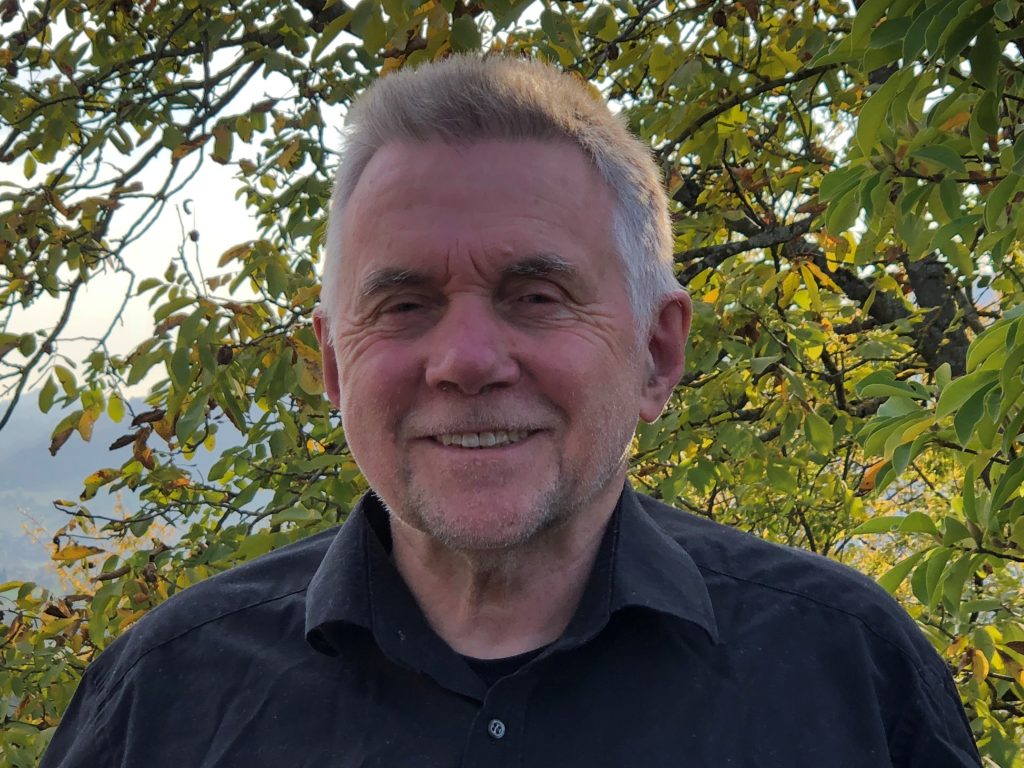
Prof. Heinz-Joachim “Hejo” Feuerstein – Coordinator of the International Focusing Institute in New York, co-founder of the Focusing Center Karlsruhe, co-founder of the European Focusing Association, and long-standing Professor of Applied Psychology at the University of Public Administration in Kehl – passed away on December 25, 2025, just a few days before his 81st birthday.

Hejo was born during the final phase of World War II. His early childhood was shaped by an atmosphere of constant threat and uncertainty. In many of his later Focusing sessions, these early experiences re-emerged: the nights of bombing, the dimmed lights, the tense silence, and the palpable fear of his mother trying to protect her child. His playgrounds were the ruins of destroyed houses—places where children played while adults struggled to comprehend and survive the aftermath of war. These formative experiences were never merely biographical facts for Hejo; they became a deep, implicit background for his lifelong interest in lived experience, embodied knowing, and the human capacity to find meaning even under extreme conditions.

Hejo was married and the father of three children: Marian, Lara, and Timon.

He studied psychology in Heidelberg and graduated as a Diplom-Psychologist. He later became Professor of Applied Psychology at the University of Public Administration in Kehl, where he gained wide recognition for his contributions to the development of team-based and process-oriented models in public administration. Alongside his academic work, his professional focus included organizational psychology, applied research, and the further development of psychotherapy, supervision, coaching, and training.

Hejo began working with Focusing in 1979 and became an accredited trainer for Person-Centered Psychotherapy and Counseling within the German Association for Person-Centered Psychotherapy and Counseling (GwG) in 1984. As one of the first German psychologists, he traveled to Chicago to meet Eugene T. Gendlin. Together with Dieter Müller, he conducted an interview with Gendlin for the German edition of Psychology Today, published in 1984. This encounter was followed by several years of intensive training at the Focusing Institute, then still based in Chicago. In 1986, Hejo was appointed Coordinator of the Institute.

In 1987, together with Dieter Müller and Reinhard Fuchs, he founded the Focusing Center Karlsruhe (FZK), where he served as scientific director. Over the years, Eugene Gendlin was invited several times to Karlsruhe for trainings and lectures. The Center hosted four International Focusing Conferences and became an important bridge between the American and European Focusing communities. This collaboration culminated in the book Focusing in Process (2000), edited by Feuerstein, Müller, and Weiser Cornell. Hejo also co-authored the foreword to the German edition of Gendlin’s Focusing: How to Gain Direct Access to Your Body’s Knowledge.

Hejo consistently emphasized that Focusing is more than a technique—it is a process deeply rooted in human experience. Central to his understanding was the insight that the human body is not only physiological, but also capable of knowing and generating meaning. This perspective shaped his lifelong commitment to holding the Person-Centered Approach and Focusing closely together, both theoretically and in practice. For him, their common ground far outweighed their differences, and he saw the TFI and the GwG as vital homes for the ongoing development of humanistic psychotherapy.

He played a key role in advancing training programs in Person-Centered Psychotherapy and Counseling. In 1999, together with Dieter Müller and colleagues, he initiated the training program Person-Centered and Focusing-Oriented Coaching and Supervision, which was recognized by the German Association for Supervision and remains highly successful today. In 2010, he launched Experiential Concept Coaching (ECC), and together with Heinke Deloch further developed Gendlin’s TAE (Thinking at the Edge), focusing on personal and scientific concept formation.

Even in his later years, Hejo remained intellectually active and creatively engaged. His most recent and perhaps most ambitious project was Experiential Decision Making (EDM)—a process model designed to support decision-making by integrating thinking and felt sensing, enabling people not only to decide, but to stand behind their decisions with inner clarity and freedom. In December 2024, the volume Focusing and Experiential Psychology was published by Adebar Verlag, edited by Reschke, Müller, Munz, Schudek, and Fischer. The book honors Hejo Feuerstein’s life and work as a co-founder of Focusing in Germany and a pioneer of Experiential Psychology in Europe, and it was dedicated to him on the occasion of his 80th birthday.

The many responses from the international Focusing community following his death speak clearly of his importance—not only as a thinker and teacher, but as a person. His contributions to the leadership of the International Focusing Institute and his role as an initiator of European cooperation were deeply respected. He was known for his ability to engage difference with openness, clarity, and genuine dialogue.

Finally, a personal word: Dear Hejo, for almost fifty years we walked a shared professional and personal path—through our work at the Focusing Center Karlsruhe and within the TFI and the GwG. Countless days were spent together in Alsace, developing projects and concepts, and many journeys took us to Chicago to learn from Eugene Gendlin. Yet what remains most vivid are not only the professional achievements, but the moments beyond work: nights in Chicago’s blues bars, travels across the United States after conferences—to Monument Valley, Grand Canyon, San Francisco, Boston, Toronto—and the many shared culinary discoveries in Alsace and Paris. You worked hard throughout your life, but you also had a deep sense of savoir vivre. It is a privilege and a source of deep gratitude that I was able to walk a long part of this path with you.

Dieter Müller

He is a licensed psychotherapist who has been deeply connected to Focusing for over four decades. He began his training with Eugene Gendlin in 1983, an experience that has shaped both his therapeutic work and his way of thinking ever since. Together with Hejo Feuerstein, he co-founded one of the first Focusing Centers in Germany. In December, he brought this work into a new form by publishing a Focusing-oriented fiction book for children.

Back to EFA posts

Back to EFA posts

1st Feb 2025

Short History of the European Focusing Association (EFA) and Appreciations of Heinz-Joachim Feuerstein

EFA Posts Uncategorized

Fiona Parr and Ruth Hirsch – for EFA – January 2025

What is the EFA?
The EFA is a European network for Focusers to develop Focusing and the Experiential Approach through collaboration, openness and mutual support. An informal organization with no hierarchy, Board or Director, EFA is open to all European Focusers. It has a Steering Group which holds the primary responsibility for organizing the next events. This group offers support to projects, but does not actually lead the EFA.

The EFA dream (from the report of the Loutraki EFA conference in 2018)
The First EFA Conference (2018) may be regarded as bringing closer the fulfillment of a dream held by a group of European coordinators who came together in 2009 [at Hejo’s home in Gengenbach] to plan a Focusing ‘academy ’where those of us in Europe could ‘cross borders ’and learn from each other, ideally working together in a cooperative and non- hierarchical way. This is not easy to achieve. For centuries, there have been wars and conflict in Europe, and there remain many challenges. We have to struggle to understand each other on a continent where there are 24 official languages and where, despite English being the most commonly used language between nationalities, the vast majority of us are not native English speakers. Our cultural assumptions and our instinctive ways of relating to each other and dealing with difficult situations are very different. Focusing takes us beyond these differences. As one German participant, who has lived his whole life in the shadow of World War II, said of a very moving interaction with one of the Israeli participants: ‘It’s not just about building one bridge, but about building many bridges between nations.’

History of EFA Meetings
EFA members met for the first official meeting in Pforzheim in 2010 and met in person almost every year since. The intention of these gatherings is to interact with one another, share, play, learn from each other, create, build connections, plan projects together, and have fun. To date, we’ve met in Greece, Italy, France, Germany, Belgium, UK, Switzerland, Spain, Italy, and during the pandemic, online on Zoom.

Some EFA activities

  • Organized and hosted the International European Focusing Conference in 2018 in Loutraki, Greece. 
  • Published two-volume compilation of articles on “Senses of Focusing” to explore issues that emerged at the 2018 Loutraki conference. This work aimed to create space for those whose first language is not English. Non-native English speakers constituted roughly half of the contributors.
  • Developed a European Oriented Focusing Coaching Training program appropriate to the multi-cultural and multi-lingual European context.
  • Hosts annual meetings for members to get together and collaborate across borders. 
  • Created an interactive website https://efa-focusing.eu, and Facebook pages.
  • Ongoing monthly online Group on teaching Focusing in Europe. 
  • Monthly online member’s meetings. 

Appreciations
Besides being one of the visionaries and founding members of EFA, Hejo has brought special and unique qualities to EFA, laying a solid foundation for an enduring legacy for the future. Following are some appreciations from EFA members that demonstrate some of Hejo’s contributions.

In an unassuming way, Hejo stands up for an open, non-hierarchical space while holding a strong vision for how we might interact. 

Living process
Hejo has the courage to let go of the normal structures that we often rely on at the expense of authentic relating. He holds out for a living process in a Focusing way; holding space for what’s going to come through. He does this by stepping back and leaving space for others in a soft and kind way.

Spontaneity
Hejo has a deeply unwavering faith in leaving space for spontaneity, for things to happen organically – the opposite of clinging to rigid structures or protocols. What he wanted and stood by was very important to him, and he transferred this to the EFA. This has meant a lot to him, and he’s given an enormous amount. He also brings a quality of authentic modesty to his way of sharing what he believes in.

Multi-lingual communication
Many also remember how, at the conclusion of gatherings, at the point when we were winding down, Hejo would surprise the group by bringing up the important subject of how we were going to work across the language barriers in Europe. It was an urgent question that cut through any sense of complacency at the end of the meeting and inspired us to revisit this important issue.

One member commented that he makes a living room for the other and always does this in a modest way. It takes enormous strength to stand back in the way that he has. 

History
We’re remembering a number of times when many of us Focusing colleagues met for a weekend to collaborate and create something together. We each spoke about our vision for EFA and what was important to us. Hejo spoke movingly about Germany’s recent history and how it brought a heavy burden for the German people. He felt that EFA could be a way forward, bringing hope and healing. He has said that EFA is like a peace project, embodying a real need for collaboration for Europeans to work together. This is what inspired many of us to contribute to the project.

As a tribute to how important it has been to Hejo to allow participation by non-native English speakers we include a few appreciations from colleagues in their native languages. 

In Dutch: Dank je wel Hejo Feuerstein, jouw drijvende levensenergie blijft stromen vanuit de wortels van de Europese Focusing Associatie (EFA) door de aderen van de boom naar waar het nu bloeit. 

In Finnish: Hejo, sinun lämpösi ja huumorintajusi ovat koskettaneet meitä kaikkia – kiitos ja kaikkea hyvää jatkoon! 

In conclusion, one member wrote: Thanks to Prof. Dr. Hejo Feuerstein`s sustainable engagement, the European Focusing Network began to flower and is more and more blooming. I remember meeting for the first time in Liege and the founding of the network and how it slowly took shape, followed by meetings in London, Spain, Greece, and Tübingen, Greece, and a few times in Italy. In all these steps, Hejo was the driving force keeping the project going and developing. Now the European vision of Focusing flows through an engaged ongoing group of people and will hopefully ignite even more European inter- living…

With deeply felt thanks and heartfelt-good wishes for his life in the 80th. 

Back to EFA posts

Back to EFA posts

5th Jan 2024

EFA-Website Instructions

EFA Posts

EUROPEAN FOCUSING ASSOCIATION (EFA) WEBSITE

Instructions for:

  • Translating the website
  • Becoming a member
  • Adding content
  • Signing up for the newsletter
  • Signing up for the discussion list

HOW TO TRANSLATE THE WEBSITE TO YOUR LANGUAGE

Simply click the Google “Select Language” field in the top blue ribbon and > Choose your language. Each time you land on a new page, it may take a moment for the translation to appear.

HOW TO BECOME A MEMBER OF EFA

HOW TO SET UP YOUR PROFILE

  • Once you have been approved as a member, set up your account and create your profile, https://efa-focusing.eu/register
  • You are now able to add content: articles, research studies, video links, your workshops/events… you need to have the copyright for text, images, and videos
  • For detailed instructions how to add content on the website, read on.

HOW TO EDIT YOUR WEBSITE PROFILE & ADD CONTENT

To make changes to your profile, please log in to your account by clicking “Log in” on the upper right blue area or by clicking menu > login, or click here: https://efa-focusing.eu/login
You will land on the “My Account” page. Click any of the links to add/change or delete your content. After you have made changes to your content, apply changes by scrolling to the bottom of the page and click on “save” or “publish”.

HOW TO GET BACK TO THE “MY ACCOUNT” PAGE

Scroll all the way up on any page and click on the “Welcome back <your first name> ” link in the blue colored area on the top right. This will take you to the ” My Account” page https://efa-focusing.eu/my-account. Edit your content as mentioned above.

DETAILS ABOUT EDITING YOUR CONTENT AND SETTINGS

Please use texts and images on the EFA website that are available for public use, e.g. those licensed under Creative Commons, or royalty-free images from websites like https://www.pexels.com/. You can also use images you have taken yourself, or ask someone the use of their own photos for this purpose. All people who show on your photos need to have agreed to you in writing, that you are allowed to use the photo in public (for promotional purposes). You cannot upload PDF files. To create a PDF file from articles members have posted, right-click on any page, select “print” then in the printer-choice dropdown-menu select PDF and save.

Post content in your language
You are welcome to enter your workshops, events, resources, articles, etc. in your own European language.
Visitors to the site will be able to filter both resources and events by language.

For the public, only filters for those languages with at least one existing entry will be visible.

EFA members directory listings:

When website users look at the EFA members directory without ticking any extra search options, all EFA members appear in the directory who have answered “yes” to the option “Make my profile publicly visible” in their profile. You can say separately “yes” or “no” to include your phone or email in your public profile.
Members who said “no” to this option will not appear for website visitors, however, logged-in, EFA members can still look at the profile of all members.
Website visitors will be able to sort members by a list or see members on a map.

The List View

The directory listing is in a randomized order (every day a new random order is generated by the website) and can be also reordered by website users alphabetically or with any of the filters on the left-hand side. Your profile will show up in all the search options, which you ticked in your profile.

The Map View
If you want to appear on the map, you need to add your location—and ideally also your postal code—to your profile. To do this, go to your “my-account” page and click “Edit my membership profile”.
Enter your town and postcode at the top of the map section. Once you’ve done this, your public profile map will display a red marker at your chosen location.

On the frontend (as visitors see it), you might need to clear your browser cache or open the page in an incognito window to see the updates.
Visitors can search EFA members by country, town, or postcode. The selected location will appear as a small, dark circle on the map, and the member list to the left will automatically sort by distance to that location.

HOW TO SIGN UP FOR THE DISCUSSION LIST

HOW TO SIGN UP FOR THE NEWSLETTER

https://efa-focusing.eu/news/newsletter/
You will receive an email within seconds and need to click the link in that email to complete the process (check your spam folder).
When you sign up for membership, you will also be asked if you would like to receive the newsletter.

Back to EFA posts

Scroll to Top